
In this article
In this article
Security teams already have visibility into a lot. Endpoints. Firewalls. Cloud workloads. Identity systems. Applications. Databases. Networks. The problem is that almost everything they monitor is also supposed to be used. That makes every signal harder to interpret.
A login may be legitimate. A database query may be expected. A file download may be normal. A new connection may belong to an application deployment. Security teams are constantly separating normal activity from activity that deserves attention.
There is another kind of visibility that can be much simpler: watch systems that nobody should be touching at all.
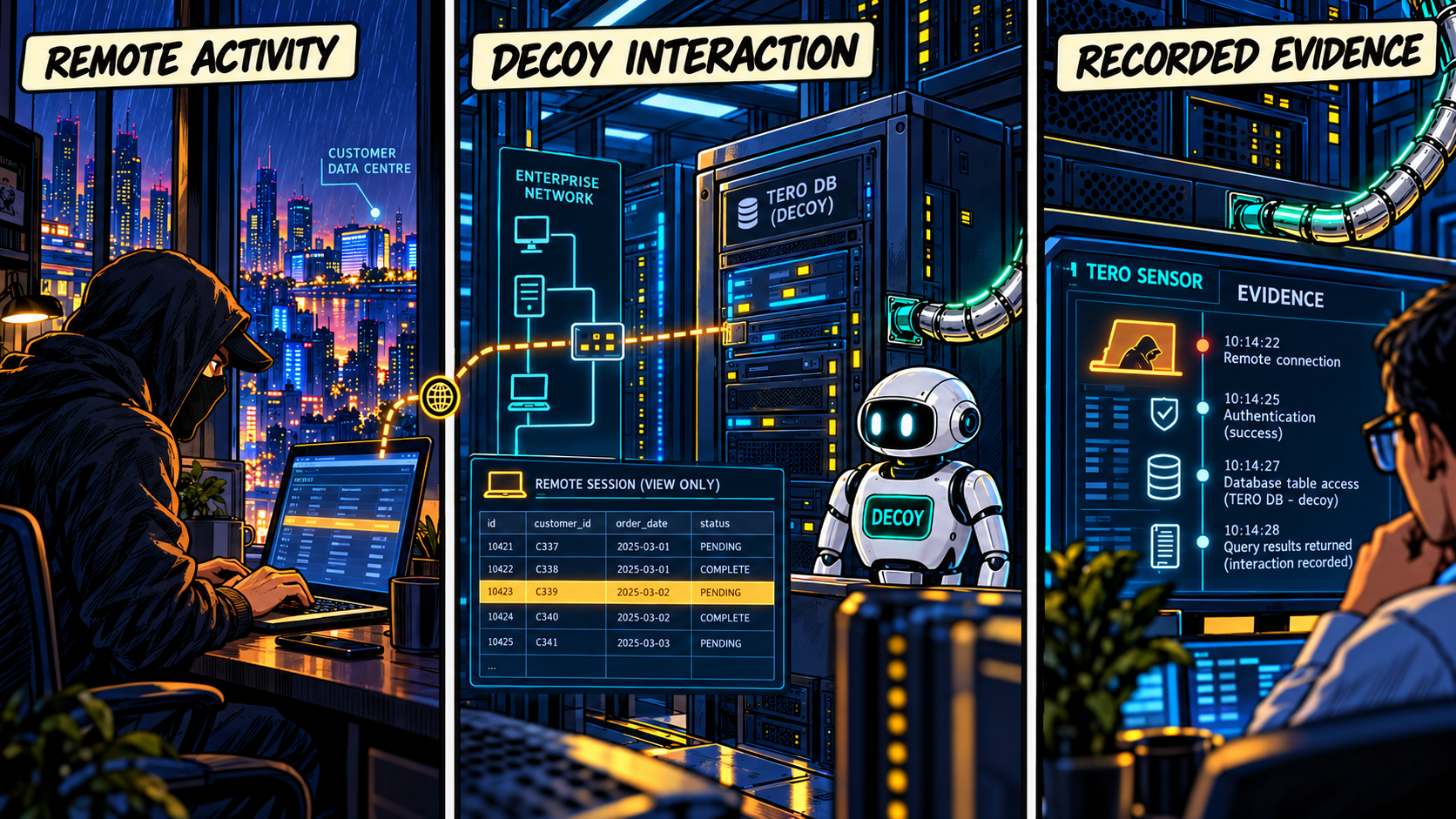
Production systems are noisy by nature
Real infrastructure exists to be used. Employees authenticate. Applications make requests. Services communicate. Administrators connect remotely. Databases process queries. That creates an enormous amount of legitimate activity.
Security tools are designed to find suspicious behavior inside that activity, and they remain essential. But the context is inherently complicated. When something unusual happens, teams often have to answer several questions before they can even decide whether to investigate. Who initiated it? Was the account legitimate? Did a deployment change? Is this normal for the application? Has this happened before? That uncertainty consumes time.
What if legitimate activity should be zero?
Now consider a system created specifically for detection. No production application depends on it. No employee workflow requires it. No administrator should need to connect to it during normal operations. If that system suddenly receives interaction, the context changes immediately.
The question is no longer:
“Is this normal behavior happening in an unusual way?
It becomes:
“Why is anyone here at all?
That is a much cleaner signal.
This is where decoys become useful
A well-designed decoy looks like infrastructure that belongs in the environment. It might appear to be:
- a MongoDB database
- a Kubernetes API
- a VPN portal
- a file server
- an internal API
- a Redis instance
- a staging application
But it exists for one reason: to make unexpected interaction visible. If someone connects, enumerates, authenticates, queries, or explores, the activity has immediate meaning because legitimate users should not be there. That does not remove the need for investigation. It gives the investigation a stronger starting point.
Visibility is most valuable when context is clear
Security teams do not need every event to become an alert. They need events that carry enough context to justify attention. Imagine seeing:
Connection to databaseThat could mean almost anything. Now compare it with:
Connection to MongoDB decoy
Database enumeration
Collection discovery
Query activity
No legitimate service dependency
The second sequence tells a much clearer story. Someone did not simply generate network traffic. They found a system and began investigating it. That is the kind of visibility Tero is designed to provide.
Nobody should be touching it — and that is the point
This idea becomes especially powerful across different environments. In a Corporate Office, the decoy might look like a VPN portal or internal file server. In Cloud/VPC, it may look like MongoDB, Redis, object storage, or Kubernetes. In Development/Test, it could be a Git server, CI/CD system, staging application, or development database.
The environment changes. The principle does not. Create believable infrastructure that legitimate users do not need, then watch what happens when someone finds it. That gives defenders another way to see activity that might otherwise blend into the background.
Better visibility creates better investigations
A useful detection should help answer:
- what was touched
- where it happened
- which environment it belonged to
- which Sensor observed it
- what actions were performed
- where the activity came from
- what happened next
That turns visibility into evidence. And evidence is what helps security teams move from:
“Something looks strange.
to:
“This interaction deserves investigation.
For a walkthrough of that full journey, read What Happens When an Attacker Touches a Tero Decoy?.
Visibility should complement the tools you already have
Tero does not need to replace the systems already monitoring production. EDR can continue watching endpoints. Firewalls can continue enforcing network policy. Cloud security tools can continue watching workloads and identities. SIEM can continue correlating events.
Tero adds a different perspective: visibility into systems that should have no legitimate traffic. That is why it fits alongside the rest of the security stack rather than competing with it.
Read more in How Tero Fits Into Your Existing Security Stack.
The signal starts with absence
Most security monitoring asks:
“Is this activity abnormal?
Decoy-based detection starts somewhere simpler:
“Should this activity exist at all?
When the answer is no, every interaction becomes more interesting. That is the opportunity. Security teams already know how to investigate real systems. Tero gives them another place to look — one where legitimate activity should be absent and unexpected behavior stands out immediately. Because sometimes the clearest signal is activity where there should be none.