
In this article
In this article
The Cost of Waiting Until Production Is Touched
Most security teams are very good at watching the systems that matter most.
Production databases.
Cloud workloads.
Endpoints.
Identity platforms.
Applications.
Critical infrastructure.
That visibility is essential.
But there is a problem with relying only on those systems for detection:
by the time an attacker touches them, they may already be too close.
If the first high-confidence signal appears when a real database is queried or a real workload is accessed, the attacker has already reached something valuable.
Tero is built around creating opportunities to detect them earlier.
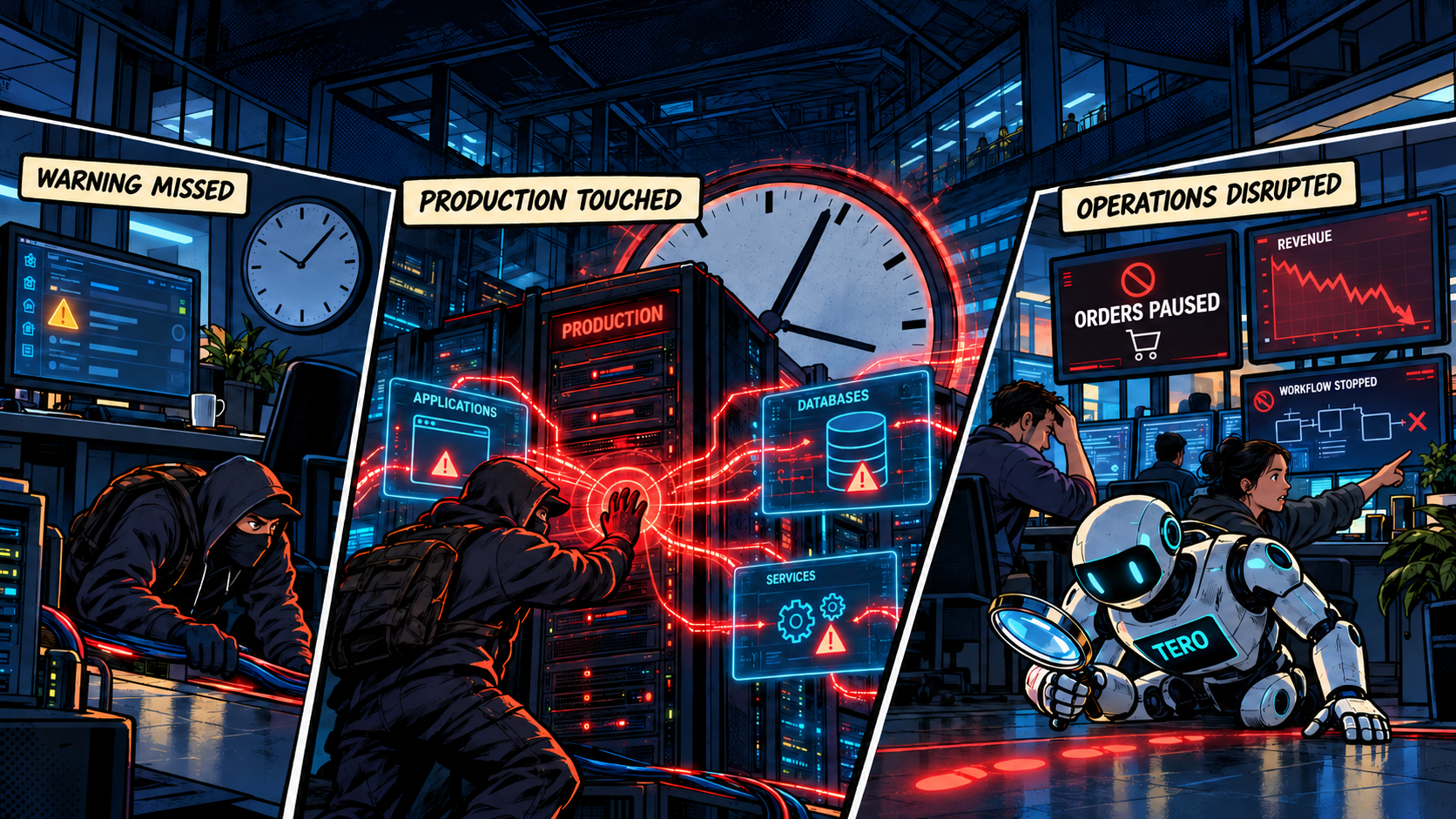
Production should not have to become the evidence
A production system exists to serve the business.
That means legitimate users and applications interact with it constantly.
So when something suspicious happens, defenders often have to work through a large amount of context before they can decide what it means.
Was the request legitimate?
Was the account expected?
Did an application change?
Is this normal traffic?
That analysis is necessary.
But it also means the system generating the signal is already a real asset.
The risk is already present.
Attackers explore before they exploit
Attackers rarely know an environment perfectly when they enter it.
They probe.
They enumerate.
They test credentials.
They look for databases, internal APIs, file shares, cloud services, development systems, remote access, and anything else that helps them understand where they are.
That exploration can happen before they reach the systems the organization cares about most.
If defenders can make that stage visible, they gain time.
And time matters.
Earlier detection changes the investigation
Consider two scenarios.
In the first, an attacker reaches a real production database and begins querying it.
The team now has to understand:
- what was accessed
- whether data was exposed
- which credentials were used
- how the attacker reached it
- what else they may have touched
In the second, the same attacker encounters a believable decoy database first.
They connect.
They enumerate.
They query synthetic data.
Now the defender gets a high-confidence signal while the attacker is still exploring something that is safe to observe.
The investigation starts earlier.
The production system never had to become the trigger.
This is where decoys create leverage
A realistic decoy gives an attacker something that looks useful without giving them something real.
It can appear to be:
- MongoDB
- Redis
- Kubernetes
- a VPN portal
- a file server
- an internal API
- a staging application
- a container registry
The asset is synthetic.
The interaction is not.
That gives defenders a chance to observe intent without putting real customer systems in the middle of the first meaningful signal.
Read more in How Tero Turns Synthetic Infrastructure Into Real Security Evidence.
Waiting creates a smaller margin for error
The closer an attacker gets to production, the less room the organization has to respond.
Reconnaissance becomes access.
Access becomes persistence.
Persistence can become lateral movement.
Lateral movement can become impact.
Not every attacker follows that exact path.
But the principle remains:
the later detection happens, the fewer safe steps remain between the attacker and something valuable.
That is why earlier visibility matters.
High-confidence signals are more useful earlier
Early detection is only helpful if the signal is credible.
Security teams do not benefit from moving the alert earlier if it simply creates more noise.
This is why believable decoys matter.
A random port being scanned may not mean much.
Someone connecting to a realistic internal service, enumerating it, and following its infrastructure relationships tells a very different story.
That is behavior worth investigating.
For more on that distinction, read Why High-Confidence Detection Matters More Than More Alerts.
Tero adds detection opportunities before production
Tero does not replace the security controls protecting your real systems.
Those controls remain essential.
Instead, Tero adds another layer of opportunity:
attacker enters environment
        ↓
reconnaissance
        ↓
discovers believable decoy
        ↓
interaction becomes visible
        ↓
security team investigates
        ↓
production remains untouched
That is the outcome we want.
Not because every attack can be stopped at the first decoy.
But because defenders should not have to wait for a real asset to become the first clear sign that something is wrong.
The best time to investigate is before impact
Security teams already know how to respond when production is compromised.
The harder problem is creating enough visibility to investigate before that happens.
Believable decoy infrastructure creates one more opportunity to do exactly that.
It gives attackers somewhere to reveal their intent.
It gives defenders something safer to observe.
And it creates a chance to act before production becomes the evidence.
See how Tero detects exploration before real systems are touched →