
In this article
In this article
Security teams already have plenty of alerts. Endpoints generate alerts. Firewalls generate alerts. Cloud platforms generate alerts. Identity systems generate alerts. Applications, networks, APIs and infrastructure all produce signals that need to be interpreted.
The problem is rarely a lack of information. The problem is knowing which information deserves attention now. That is why Tero is built around a different goal: not more alerts — higher-confidence detection.
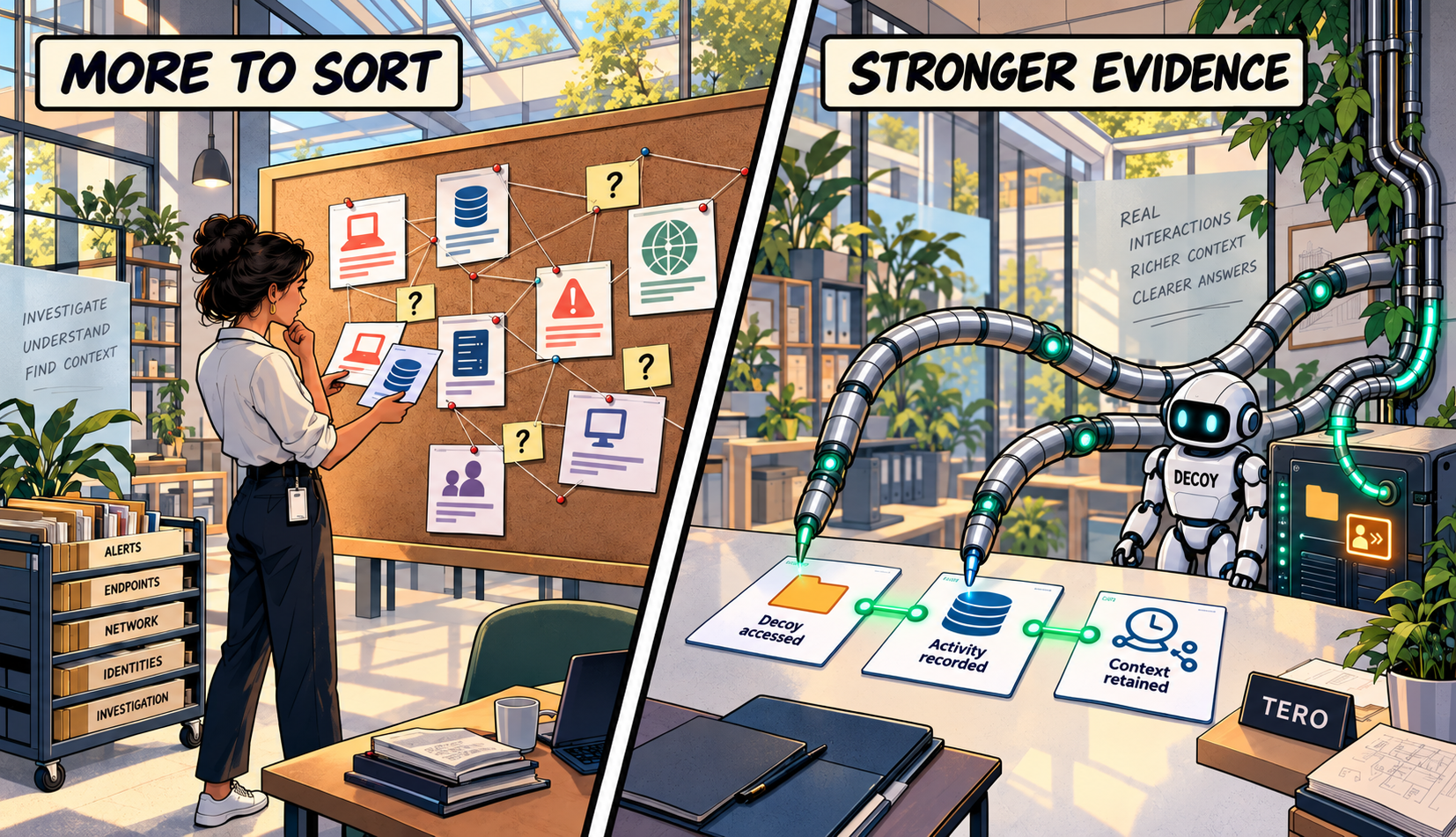
More visibility can still create more uncertainty
Most security tools monitor legitimate infrastructure. That is necessary. But legitimate infrastructure also produces legitimate activity. A database connection might be normal. An administrator logging into a server might be expected. A user downloading a file might be harmless. A process opening a network connection might be part of normal application behavior. Every signal comes with context that has to be interpreted. That creates an unavoidable question:
“Is this activity actually malicious?
The more complex the environment becomes, the harder that question can be to answer quickly.
A decoy changes the question
Now imagine a system that exists specifically for detection. It looks real. It behaves like infrastructure someone might reasonably expect to find. But legitimate users and applications have no reason to interact with it. That changes the investigation immediately. Instead of asking:
““Is this activity unusual?”
the security team can ask:
““Why is anyone touching this system at all?”
That is a much stronger starting point. A connection to a Tero decoy is not automatically proof of a breach. But it is a signal with far less legitimate explanation than activity against production systems. That makes it useful.
High confidence comes from intent
Attackers explore. They enumerate services. They test credentials. They query databases. They inspect APIs. They look for files, infrastructure and systems that might help them move further. Tero places believable services into that path. For example, a Cloud/VPC environment might include:
- Kubernetes API
- MongoDB
- Redis
- Object Storage
- Docker Registry
- Internal API
If someone begins interacting with one of those decoys, Tero can capture that activity as evidence. The value does not come from simply opening another port. It comes from creating infrastructure that is worth investigating and then recognizing when someone investigates it.
If you want to see how we approach that realism, read How to Implement Decoys That Attackers Actually Believe.
Fewer assumptions, faster investigation
High-confidence detection helps reduce the amount of interpretation required before someone starts investigating. Consider two scenarios. A production database receives an unusual query. The security team may need to determine:
- which application sent it
- whether the account is legitimate
- whether the query is expected
- whether a deployment changed recently
- whether the behavior is malicious
Now consider a decoy database receiving a query. There should be no legitimate application depending on it. There should be no normal user workflow requiring it. That does not eliminate investigation. It gives the investigation a much stronger starting point.
Detection should complement the existing stack
Tero is not designed to replace the systems already monitoring production. EDR still matters. SIEM still matters. Network visibility still matters. Cloud security still matters. Those systems protect and observe the infrastructure the organization actually depends on.
Tero adds another layer: visibility into infrastructure nobody should be using. That distinction is important. Your existing security stack watches the systems people are supposed to touch. Tero helps watch the systems they are not.
Read more in Add Protection Without Replacing Everything Else.
Realistic decoys make the signal stronger
The usefulness of a decoy depends on whether someone believes it is worth exploring. An obvious fake service may be ignored. A believable environment gives an attacker reasons to continue.
A Kubernetes configuration can reference a registry. The registry can contain matching images. An application can reference MongoDB. MongoDB can contain believable synthetic records. The systems reinforce each other. That creates more opportunities to observe exploration and understand what someone is trying to do.
Our Cloud/VPC environment is one example of that approach. See Protecting the Cloud With Decoys That Actually Belong There.
High-confidence detection gives teams something they can act on
Security operations should not be a competition to generate the largest number of alerts. The useful question is: How quickly can the team identify activity that genuinely deserves attention?
Tero is designed to improve that signal by introducing systems with almost no legitimate reason to receive interaction. When somebody finds them, connects to them or begins exploring them, the security team gets an opportunity to investigate activity that might otherwise remain buried inside normal infrastructure noise. That is the difference between simply seeing more activity and seeing something worth acting on.
More signals are not the goal
Security teams already have data. What they need is confidence. Confidence that an interaction is unusual. Confidence that an investigation is worth starting. Confidence that they are not spending their time chasing another harmless production event. That is the role Tero is designed to play: realistic infrastructure, unexpected interaction, clearer evidence.
Want to see what that looks like in practice?