
In this article
In this article
What Makes a Tero Decoy Different From a Basic Honeypot?
A basic honeypot has a simple purpose:
Put something fake on the network and wait for someone to touch it.
That idea is useful.
But it is also limited.
A service can be technically reachable and still look obviously artificial.
It can generate an event without creating enough realism to hold an attacker’s attention.
It can exist as a one-off trap without fitting naturally into the environment around it.
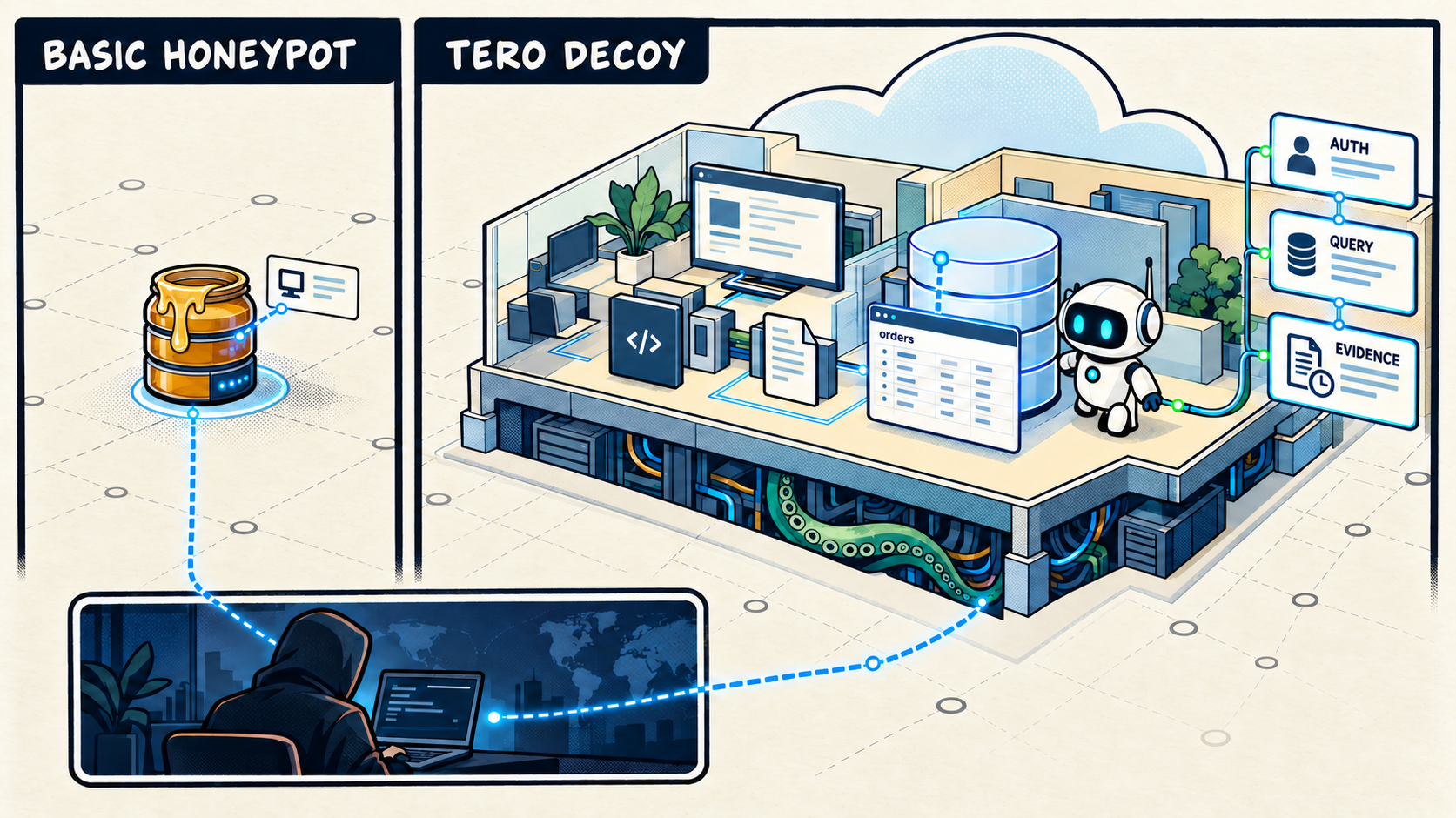
Tero takes the same core idea — exposing infrastructure nobody should be touching — and pushes it much further.
The goal is not just to create a fake service.
The goal is to create believable infrastructure that fits the environment, behaves realistically, and produces evidence security teams can actually use.
1. Realism instead of obvious bait
A basic honeypot may only need to respond.
A Tero decoy needs to make sense.
That means thinking about details such as:
- service behavior
- naming
- authentication
- data
- timestamps
- relationships
- error responses
- network placement
A MongoDB decoy should feel like MongoDB.
A VPN portal should feel like a corporate VPN portal.
A Kubernetes API should behave like something an operator would recognize.
The goal is not theatrical realism.
It is operational realism.
Something that looks ordinary enough that an attacker has a reason to keep exploring.
Read more in How to Implement Decoys That Attackers Actually Believe.
2. Shared personas across services
A single realistic service is useful.
Several realistic services that agree with each other are much stronger.
Tero environments can share synthetic identity and infrastructure context.
That means one decoy can reinforce another.
For example:
Kubernetes
    ↓
references an internal image

Container Registry
    ↓
contains that image

Application config
    ↓
references MongoDB and Redis

MongoDB
    ↓
contains related application data

Internal API
    ↓
appears to serve the same environment
The assets are synthetic.
But the relationships are coherent.
That matters because attackers do not evaluate each service in isolation.
They build a picture.
Tero is designed so that picture can keep making sense.
3. Environment-aware deployment
A decoy should look like it belongs where it is deployed.
That is why Tero separates different environments such as:
- Corporate Office
- Cloud / VPC
- Data Centre
- Branch Office
- DMZ / Edge
- Development / Test
A Corporate Office may reasonably contain:
VPN Portal
SMB
RDP
WinRM
Internal Web
Domain Controller
A Cloud/VPC environment may instead contain:
Kubernetes API
MongoDB
Redis
Object Storage
Container Registry
Internal API
The platform stays consistent.
The infrastructure changes with the context.
That is a very different model from deploying the same generic trap everywhere.
See the broader approach in One Platform, Many Environments.
4. Protocol fidelity matters
A convincing service has to survive more than a glance.
Attackers use real tools.
They connect with database clients.
They enumerate APIs.
They query services.
They inspect responses.
That is why Tero treats protocol behavior as part of believability.
A database decoy should respond like a database.
An API should behave like an API.
A remote-access service should expose realistic authentication and session behavior.
The closer the interaction gets to the way the real service behaves, the more useful the resulting activity becomes.
A basic honeypot might tell you:
“Someone connected.
A higher-fidelity decoy can tell you:
“Someone connected, enumerated, authenticated, queried, and followed a relationship into another service.
That is a much richer signal.
5. Centralized management
Traditional honeypots can become difficult to operate at scale.
Different services.
Different machines.
Different configurations.
Different logging.
Different lifecycle management.
Tero centralizes that model.
The customer works with:
Environment
    ↓
Sensor
    ↓
Decoy
A Sensor provides the deployment point.
Decoys are managed through the Tero platform.
The customer can add new decoys without treating every service as a separate independent security project.
That means coverage can grow while the operating model stays understandable.
Read more in Why Tero Separates Environments, Sensors and Decoys.
6. Evidence, not just events
The biggest difference is what happens after the interaction.
A basic honeypot often ends with:
connection detectedTero is designed to build more context around what happened.
That can include:
- which decoy was touched
- which environment it belonged to
- which Sensor observed it
- what actions were performed
- how the activity progressed
- what was explored next
- where the interaction originated
That turns an event into evidence.
And the more deliberate the attacker’s behavior becomes, the more useful that evidence becomes.
For example:
connection
→ authentication attempt
→ enumeration
→ query
→ service discovery
→ further exploration
Now the team has a timeline.
Not just a notification.
7. Tero fits into the rest of the security stack
Tero does not need to replace EDR, SIEM, firewalls, cloud security, or logging.
Those tools remain essential for protecting and understanding production systems.
Tero adds another source of evidence:
activity against systems that should have no legitimate use.
That makes decoy interactions particularly useful as a starting point for investigation.
A Tero event can lead the team into:
EDR
Identity
Firewall logs
Cloud audit trails
SIEM
Network telemetry
The decoy gives the team a reason to look.
The rest of the stack helps explain the full picture.
Read more in How Tero Fits Into Your Existing Security Stack.
A decoy should be more than something fake
The most useful decoys are not just fake systems.
They are believable systems with a clear purpose.
They fit into the environment.
They behave consistently.
They reinforce one another.
They are centrally managed.
And when somebody interacts with them, they create evidence with context.
That is the difference Tero is aiming for.
A basic honeypot asks:
“Did someone touch this?
Tero asks:
“What did they find, what did they do, where did they go next, and what does that tell us?
That is a much more useful question for a security team.
See how Tero turns believable decoys into actionable evidence →