In this article
In this article
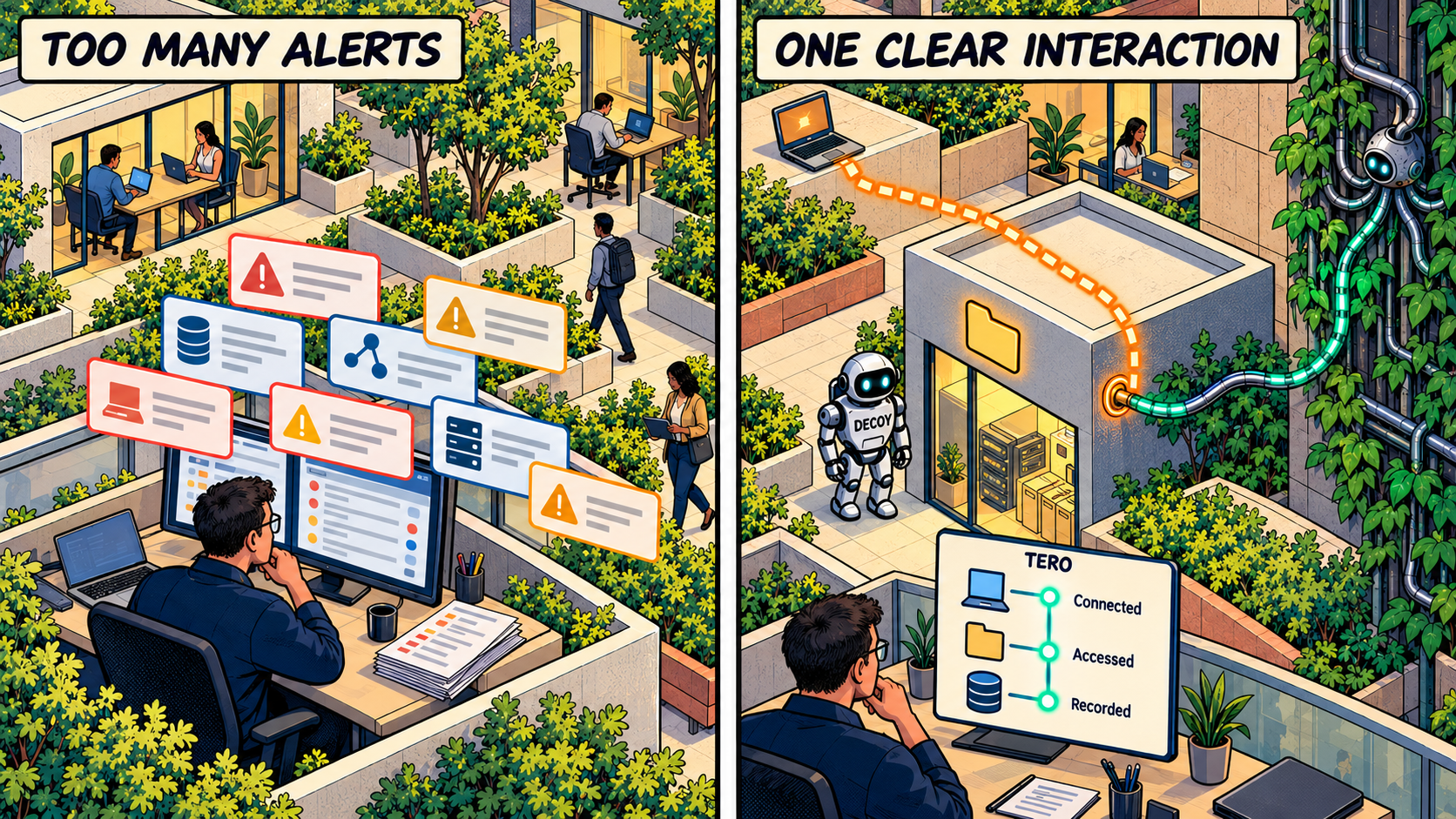
Most organizations do not have a security data problem. They have a signal problem. Modern security teams already operate endpoint protection, identity controls, network monitoring, cloud security, firewalls, SIEM platforms and a growing collection of specialist tools. All of those systems generate telemetry. The challenge is deciding what genuinely deserves attention. When every platform produces alerts, investigations become slower, analysts spend time validating noise, and important activity can become harder to distinguish from ordinary operations.
Tero is being built around a different idea. Instead of only monitoring the systems your employees and applications legitimately use, Tero gives suspicious activity somewhere else to go. Realistic decoys create assets that should not receive normal business interaction. When somebody discovers, probes, authenticates to or interacts with those systems, the signal starts from a fundamentally different place.
Detect activity that should not be there
Traditional security products often have to answer a difficult question: Is this normal behaviour or malicious behaviour? That can be complicated. A production database receives valid connections every day. Administrators legitimately use remote management tools. Employees access file shares. Applications communicate across internal networks.
A decoy is different. It is deliberately placed where it can be discovered, but legitimate users should have no reason to interact with it. That means an unexpected interaction is immediately interesting. Tero helps organizations create those signals using believable services deployed inside the environments they want to protect. The objective is simple: Give suspicious exploration somewhere safe to reveal itself.
Add another layer without replacing your security stack
Security teams have already invested heavily in the tools they use today. Tero is not designed to ask them to throw those investments away. Endpoint protection still matters. Identity security still matters. Network monitoring still matters. SIEM still matters.
Tero adds a different type of visibility alongside them. Where traditional tools monitor genuine business activity for signs of compromise, deception introduces infrastructure whose interaction is inherently unusual. That makes Tero useful as an additional detection layer rather than a replacement for everything already in place.
For security leaders, that means deception can be introduced incrementally. Start with a Sensor. Deploy decoys in an environment where suspicious exploration would matter. Observe what happens. Expand from there.
Make the environment believable enough to matter
A decoy only works if it looks like it belongs. Attackers pay attention to details. Hostnames. Protocols. Services. Credentials. Data. Network context. A database called honeypot-db provides very little deception. A system that looks consistent with the surrounding environment is different.
Tero is designed around realistic decoy infrastructure rather than superficial open ports. Decoys can represent services such as:
- PostgreSQL
- MySQL
- Microsoft SQL Server
- RDP
- WinRM
- Domain Controller-style infrastructure
The goal is not to duplicate your production environment. It is to create believable assets that fit naturally enough into it to generate useful interaction.
See more than an alert message
A detection is only useful if somebody can investigate it. Tero is designed to preserve the evidence behind suspicious activity. That can include:
- which decoy was accessed
- which protocol was involved
- when the interaction occurred
- source information when it can be reliably established
- authentication attempts and outcomes
- supporting event metadata
- related activity from the same interaction
Instead of presenting security teams with another unexplained red notification, the objective is to provide context immediately. What happened? Where did it happen? How serious was it? What evidence supports the alert? Those are the questions an analyst needs answered before they can make a decision.
Reduce the distance between detection and investigation
Security incidents rarely become expensive because somebody failed to collect enough logs. The cost often comes from time. Time before suspicious activity is noticed. Time spent deciding whether an alert is real. Time spent reconstructing what happened. Time spent finding the systems involved.
Deception can reduce part of that distance. When an attacker begins exploring infrastructure they should never have touched, the interaction itself becomes a reason to investigate. Tero then connects that alert to the supporting evidence collected by the Sensor. The security team starts closer to the actual question: What is interacting with this environment, and why?
Deploy close to the infrastructure you care about
The Tero Sensor runs inside the environment being protected. It manages the deceptive services configured for that environment and reports relevant activity back to the Tero control plane. This model allows organizations to place deception where it makes operational sense. For example:
- corporate networks
- office environments
- cloud environments
- infrastructure segments
- isolated networks
- development environments
Multiple Sensors can provide coverage across different environments while the Tero console gives teams a central place to monitor them. That keeps the detection point close to the infrastructure while keeping investigation centralized.
Keep deceptive infrastructure separate from production data
Security tooling should not create additional exposure. Tero decoys are intended to use controlled synthetic identities, credentials and data rather than genuine production information. The purpose is to create convincing infrastructure without placing real customer records or production secrets inside the deception layer.
That separation matters. A decoy should be attractive to an attacker while remaining safe for the organization deploying it. The result is infrastructure designed to be explored without turning that exploration into access to real business systems.
Give security teams a signal worth investigating
More alerts are not the objective. Better decisions are. Security teams already face enough dashboards, queues and event streams. A new product should earn its place in the stack by giving defenders information they did not already have.
Tero does that by creating systems that legitimate users should not need. When those systems are touched, the interaction becomes valuable precisely because it is unusual. That gives organizations another way to identify:
- reconnaissance
- credential testing
- unauthorized service access
- lateral exploration
- interaction with internal-looking infrastructure
It is a simple idea with an important operational advantage: The signal begins before an attacker needs to reach a real asset.
Built for teams that want earlier visibility
Tero is relevant for organizations that want to strengthen visibility inside their environments without adding another enormous telemetry project. It can be especially useful for teams that:
- operate valuable internal infrastructure
- want additional visibility into lateral exploration
- need better evidence around suspicious network activity
- are concerned about credential misuse
- want to introduce deception without rebuilding their security architecture
- need security controls that can expand across multiple environments
The platform is being designed to remain understandable for the people actually responsible for operating it. Deploy Sensors. Create decoys. Monitor activity. Investigate the interactions that should not be happening.
Security should create clarity
The value of security technology is not measured by how complicated it looks. It is measured by whether it helps organizations reduce risk. That means giving defenders useful signals. Showing the evidence behind them. Making uncertainty visible. And helping teams understand suspicious behaviour before it reaches the systems that matter most.
“The best security signal is one your team understands immediately and knows deserves attention.
— Tero Engineering
See how Tero fits into your environment
Every organization has a different network, different infrastructure and different security priorities. That is why the best way to evaluate deception security is to see it working against an environment that resembles your own. In a Tero demo, we can walk through:
- how Sensors are deployed
- how realistic decoys are created
- how suspicious interactions are detected
- what evidence Tero collects
- how alerts are investigated in the console
- where deception could fit alongside your existing security stack
If your organization is looking for another way to detect suspicious activity earlier and give defenders clearer evidence, we would be happy to show you Tero.
Request a demo and see how deception security could fit into your environment.