In this article
In this article
Most companies already have security tools. Endpoint protection. Identity controls. Firewalls. Cloud security. Network monitoring. SIEM. Vulnerability management. The modern security stack is not short on visibility. The harder problem is deciding which activity genuinely deserves attention. Most security products monitor systems that employees, applications and administrators use every day. That means legitimate and potentially malicious behaviour often exist in the same stream of telemetry.
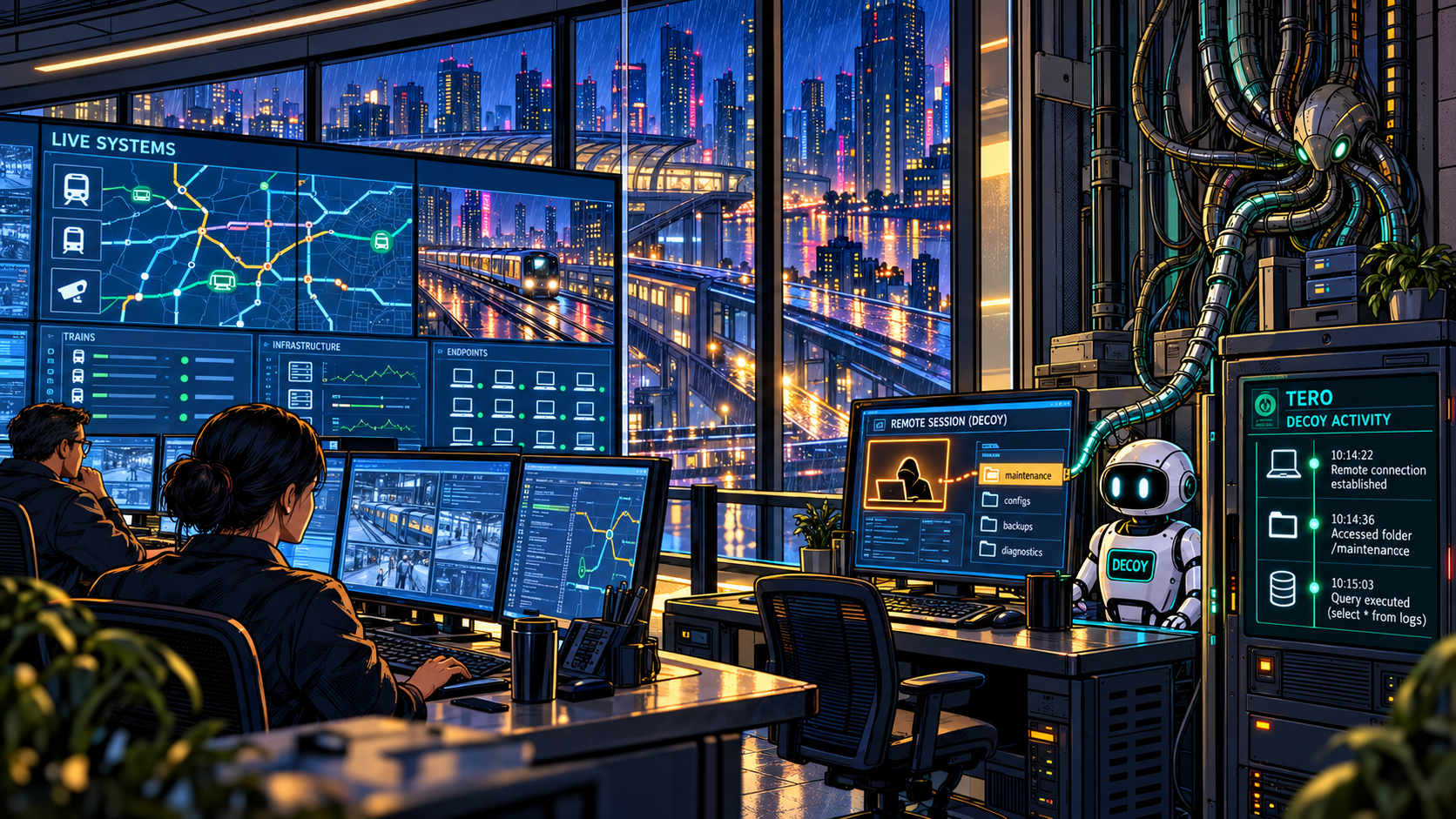
Tero introduces a different kind of signal. Instead of only watching the systems your business actually depends on, Tero gives suspicious activity realistic infrastructure that nobody should legitimately be interacting with. That distinction changes the starting point of detection.
Your real infrastructure is supposed to receive traffic
A production database is supposed to receive connections. A file server is supposed to be accessed. Remote administration services may legitimately be used by IT teams. Cloud applications communicate constantly. This creates one of the fundamental difficulties of security monitoring. Activity happens first. Then security systems have to determine whether that activity is normal, unusual or malicious.
That requires context. Identity. Behaviour. History. Rules. Baselines. Correlations. Sometimes those systems make the distinction very well. But the underlying challenge remains: the asset being monitored is supposed to be used.
A decoy starts from the opposite assumption
A deception asset exists for a different reason. Nobody should need it. There should be no legitimate business workflow that requires an employee to authenticate to the decoy database. No application should depend on the deceptive file server. No administrator should accidentally need the decoy remote-management service. That makes interaction inherently interesting. The question changes from:
“Is this normal behaviour that happens to look suspicious?
to:
“Why is anyone interacting with this system at all?
That is the fundamental value of deception security. It creates infrastructure where unexpected interaction is the signal.
Give attackers somewhere safe to reveal themselves
Attackers rarely begin by immediately compromising the most valuable system in an organisation. They explore. They discover services. They test credentials. They inspect network relationships. They look for databases, administrative interfaces, internal applications and accessible infrastructure.
This discovery process creates an opportunity. If some of what the attacker discovers is controlled deceptive infrastructure, the organisation may gain visibility before the attacker reaches a real asset. That is the role Tero is designed to play. Tero Sensors deploy and manage believable decoys inside the environments you choose to protect. Those decoys can resemble infrastructure an attacker may reasonably expect to find, including technologies such as:
- PostgreSQL
- MySQL
- Microsoft SQL Server
- RDP
- WinRM
- Domain Controller-style services
The objective is not simply to expose ports. The objective is to create systems worth interacting with.
Realism determines whether deception works
Attackers inspect infrastructure. A service called:
honeypot-01
does not require much analysis. Neither does a database filled with obviously fake tables and meaningless data.
Useful deception needs context. A system called:
BCN-FIN-DB01
with a believable service, realistic synthetic data and credentials that fit its apparent purpose tells a different story. It might reasonably exist. That is enough to encourage further interaction. Realism can come from many small details:
- naming conventions
- service selection
- host roles
- synthetic identities
- database schemas
- plausible files
- credentials
- protocol behaviour
- network placement
None of those elements needs to contain real sensitive business information. The strongest deception reproduces the shape of a real environment without exposing the real environment itself.
Earlier interaction can mean earlier visibility
The business value of deception is not that it produces another category of alert. It is where in the attacker's journey the interaction can occur. If suspicious activity touches a decoy while the attacker is still exploring the environment, the security team may gain an investigative lead before a production system becomes the focus. That can change the response conversation considerably.
Instead of beginning with:
“A real server appears to have been compromised.
the investigation might begin with:
“An unexpected source is authenticating against infrastructure that no legitimate user should know or care about.
Those are very different starting points. Tero is designed to make that unexpected interaction visible.
Tero does not replace the security tools you already use
Introducing a new security capability should not require rebuilding the security programme around it. Tero is not intended to replace:
- endpoint detection and response
- identity security
- network security
- SIEM
- firewalls
- cloud security
- vulnerability management
Those products protect and monitor systems that matter directly to the business. Deception complements them by creating something they generally do not provide: assets whose interaction is unusual by design.
This gives security teams another signal they can combine with the evidence they already collect. A suspicious source detected by Tero can be investigated across endpoint, identity, network and SIEM platforms. The deception event becomes another piece of the wider security picture.
A useful alert needs evidence
Detecting an interaction is only the beginning. An analyst still needs to understand what happened. Tero is being built so alerts remain connected to the evidence behind them. That can include:
- the decoy involved
- the service or protocol
- time of interaction
- authentication attempts
- successful or failed outcomes
- source information when it can be reliably established
- related activity
- supporting event metadata
The objective is not:
“Something suspicious happened.
It is:
“Here is what happened, where it happened, and the evidence we observed.
That difference matters when a security team has to decide whether to escalate an incident.
High signal does not mean high volume
A deception deployment should not continuously create security alerts while nothing interesting is happening. In fact, one of the most valuable properties of deception can be its relative quietness. If nobody is interacting with the deceptive infrastructure, the customer should not receive thousands of alerts simply because the platform itself is performing health checks.
Tero separates operational service activity from customer security activity. Readiness checks, internal management traffic and service supervision should remain operational concerns. Unexpected interaction with the deceptive environment is what should reach the security investigation workflow. The goal is not a bigger queue. The goal is a better reason to look.
Deploy deception where it makes sense for your company
Every organisation has a different environment. Some operate primarily in cloud infrastructure. Others still depend heavily on office networks, internal applications and on-premise systems. Many operate across both.
Tero's Sensor model is designed to support that reality. Sensors can be placed close to the environments being protected, while the Tero console provides a centralized place to manage decoys and investigate activity. That makes it possible to introduce deception incrementally. For example:
- deploy a Sensor in one environment
- create a small number of relevant decoys
- monitor interactions
- evaluate the signal
- expand coverage where appropriate
The organisation does not need to redesign its network just to begin evaluating deception.
What companies should expect from deception security
Buying another security product should not simply mean buying another dashboard. Companies evaluating deception should ask harder questions.
Are the decoys believable?
Would the systems make sense inside the environment where they are deployed?
Is the infrastructure isolated?
Can attackers interact with the deception layer without gaining access to genuine production data?
Can the team understand the alerts?
Does the product provide evidence, or merely announce that something happened?
Does it create unnecessary operational work?
Can the environment be deployed and maintained without becoming another infrastructure project?
Can it complement the existing security stack?
Does the product add a new signal rather than requiring the organisation to replace tools that already work?
These are the questions we are building Tero around.
Security teams need signals they can explain
Security leaders are ultimately responsible for decisions. Do we investigate? Do we escalate? Do we isolate a machine? Do we reset credentials? Do we involve incident response?
Those decisions require confidence. That is why we believe security tooling should expose the evidence behind its conclusions. Deception has an advantage here. The starting signal is already unusual. If Tero can combine that signal with believable decoys, reliable telemetry and investigation context, it can provide defenders with something increasingly valuable: a reason to pay attention.
“Tero does not try to watch everything. It creates systems where unexpected interaction means something.
— Tero Engineering
Give attackers another path. Give defenders another signal.
The modern security stack is essential. But most of it is focused on protecting and observing real infrastructure. Tero adds another layer. A controlled environment designed to attract suspicious exploration. A Sensor close to the infrastructure. Realistic decoys. Evidence behind the interaction. And a central console where the security team can understand what happened.
The objective is not to make security more complicated. It is to create another opportunity to see an attacker before the attacker reaches something important.
See how Tero would fit into your environment
Deception is easiest to understand when you see it operating. In a Tero demo, we can show you:
- how the Sensor is deployed
- how decoys are created
- how they can be adapted to different environments
- what happens when somebody discovers them
- how authentication and service activity are captured
- how events become alerts
- how investigation evidence appears in the Tero console
We can also discuss where deception would make sense inside your own security architecture. If your organisation is looking for another way to identify suspicious exploration earlier without replacing the tools you already rely on, we would be happy to show you Tero.
Request a demo and see what happens when attackers find infrastructure designed to notice them.