
In this article
In this article
Security teams do not make decisions based on alerts alone. They make decisions based on whether they trust the evidence behind those alerts. A notification may say that a login succeeded, a database was accessed or a suspicious connection occurred. But before an analyst escalates an incident, blocks a source or begins a wider investigation, they need confidence that the underlying telemetry actually represents what the product says it represents.
That distinction matters. Security operations already generate enormous volumes of data. The value of another security product is not simply that it can produce more events. It is whether those events can be understood, verified and acted upon. At Tero, we believe trustworthy telemetry is one of the foundations of useful deception security.
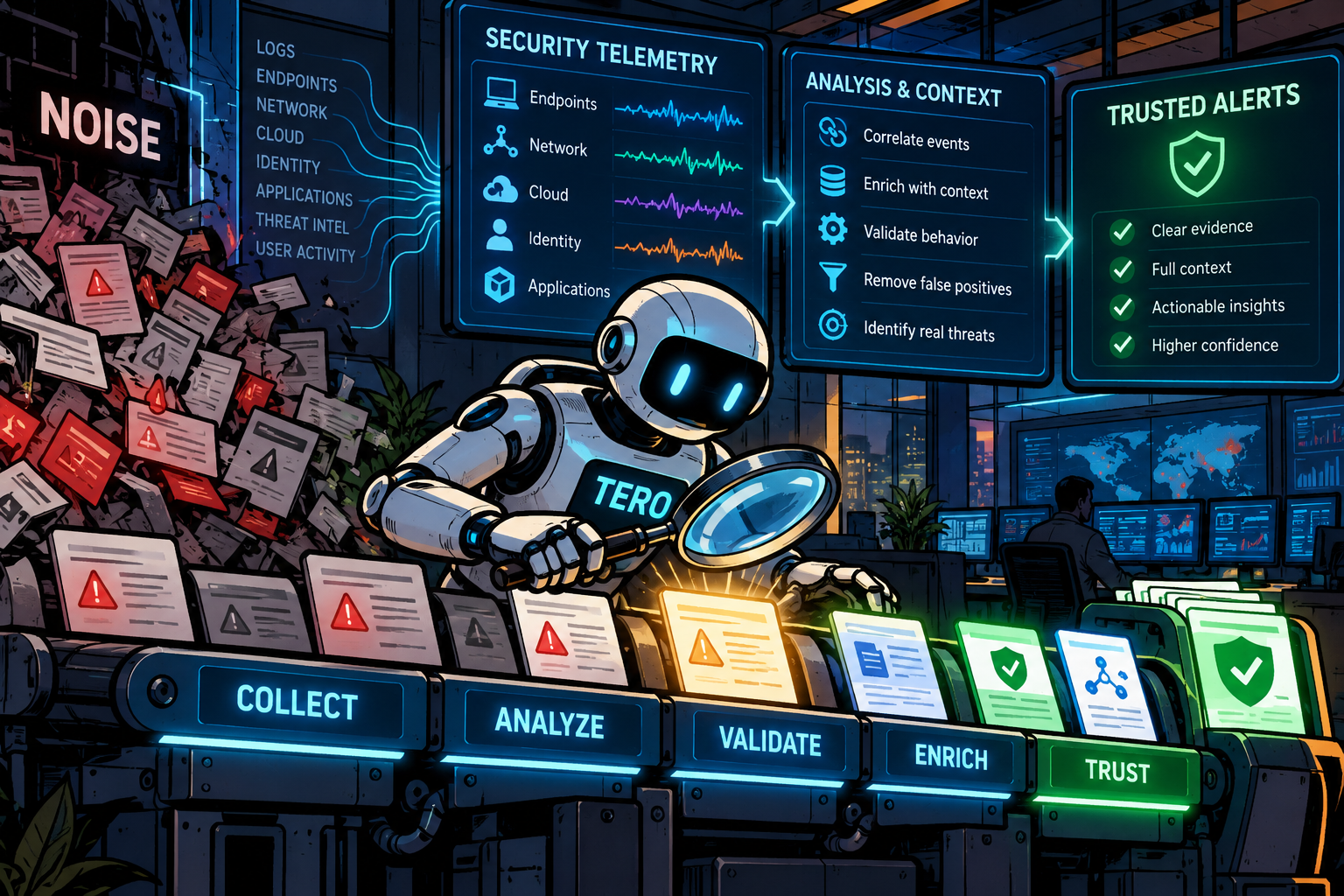
An alert is only as good as the evidence behind it
Consider an alert that says:
"Database login succeeded."
That sounds important. But immediately, an analyst has more questions. Which database? Which decoy? Which account was used? Where did the interaction originate? Was the source address observed directly or inferred? When exactly did the activity occur? Did anything happen before or after the authentication? Was this genuine external activity or simply an internal health check?
Without those answers, the alert creates another investigation task. With them, the analyst starts with evidence. That is the difference between producing telemetry and producing useful security intelligence.
High confidence starts with knowing what should not happen
One of the strengths of deception security is that the systems being monitored are intentionally different from ordinary production assets. A real database has legitimate users. A real file server receives legitimate requests. A real administrative service may be accessed every day.
A decoy should have little or no legitimate business interaction. That gives defenders a fundamentally different signal. When something begins interacting with deceptive infrastructure, the question is no longer:
"Is this normal activity that happens to look suspicious?"
It becomes:
"Why is this system being touched at all?"
That does not eliminate the need for investigation. It does reduce the amount of normal business activity that defenders have to separate from genuinely unexpected behaviour.
Source attribution needs context
Source IP addresses are frequently presented as if they are absolute facts. In real infrastructure, they are not always that simple. Traffic may pass through:
- containers
- gateways
- proxies
- relays
- network address translation
- internal routing layers
The address visible to one service may not be the address that originally initiated the interaction. That means a trustworthy security system should distinguish between what it knows and what it believes.
If Tero can reliably correlate an external connection to the native activity generated inside a decoy, that attribution should be visible. If no reliable external source can be established, the product should say so rather than invent certainty. That transparency matters because defenders may make consequential decisions based on source information.
Timestamps tell the story
Time is another simple field that becomes extremely important during investigation. One event may not reveal much. A sequence can. A suspicious interaction might look like:
- connection established
- authentication attempted
- credentials accepted
- query executed
- session ended
When those events are accurately timestamped, the analyst can reconstruct what happened. They can also compare Tero activity with evidence from other systems:
- SIEM
- endpoint telemetry
- firewall logs
- identity providers
- cloud audit logs
Good timestamps allow deception telemetry to become part of a wider investigation rather than an isolated alert.
Outcomes matter more than attempts alone
Not all attacker activity has the same significance. A connection attempt tells you that somebody found a service. A failed login tells you that somebody tried to use it. A successful login indicates something more serious. A subsequent query or command provides stronger evidence again.
Treating all of these outcomes identically removes useful information. Tero is designed to preserve those differences. The analyst should be able to understand whether an interaction was:
- attempted
- rejected
- successful
- continued into additional activity
That context helps determine severity and investigative priority.
Security tools must understand their own activity
Trust also requires the product to recognise itself. Sensors perform health checks. Services verify readiness. Infrastructure components communicate with each other. Those actions are operationally necessary, but they are not attacks. If a deception platform cannot distinguish its own management traffic from suspicious activity, it can generate thousands of alerts while nothing malicious is happening. That destroys confidence quickly.
A quiet environment should remain quiet. Internal readiness and service-management activity should be filtered before it becomes customer security telemetry. When the platform does generate an alert, the customer should have a reason to pay attention.
Provenance makes uncertainty visible
One principle we consider important at Tero is provenance. It is not enough to store a value. Where possible, the system should also understand where that value came from. For example, a source address may come from:
- the externally observed connection
- an ingress correlation
- native service logs
- a network relay
- an unknown source
These are not equivalent. Showing the provenance of evidence allows an analyst to judge its reliability instead of being asked to blindly trust the interface. Good security products should expose uncertainty rather than hide it.
Deception can reduce the signal problem
Security teams often have excellent tools already. The challenge is that many of those tools monitor environments where legitimate activity and malicious activity coexist. That creates enormous volumes of telemetry. Deception offers a useful complement. Instead of attempting to classify every action happening across production, it creates infrastructure specifically designed to detect unexpected interaction.
That means the signal begins from a different place. The system does not need to prove that every connection is malicious. It needs to show that somebody interacted with something they had no legitimate reason to touch. When combined with trustworthy evidence, that can give analysts a much faster starting point.
What Tero is building
Tero is being built around a straightforward idea: If an alert asks a security team to investigate something, the product should provide enough context to justify that request. That means connecting alerts to the events behind them. It means preserving outcomes. It means showing source information honestly. It means distinguishing internal platform activity from genuine interactions.
And it means giving analysts a clear path from:
alert
to:
evidence
to:
investigation.
The objective is not another dashboard full of unexplained red indicators. It is a security signal that a defender can understand.
“Trust in security telemetry comes from knowing not only what happened, but how the system knows it happened.
— Tero Engineering
From more alerts to better decisions
Security teams do not need every possible event promoted into an alert. They need the right events, with enough context to make a decision. That is where we believe deception can be especially valuable.
A realistic decoy creates an environment that should not receive normal business activity. A Tero Sensor observes what happens there. The Tero control plane turns those observations into evidence that defenders can investigate. The result is not intended to replace the rest of the security stack. It gives that stack another kind of signal. One built around activity that should not have happened in the first place.
See the signal for yourself
The best way to understand deception security is to interact with it. In a Tero demo, you can see how a Sensor deploys decoys, how suspicious interactions become events, and how those events appear as evidence inside the console.
If your security team is looking for higher-confidence ways to identify unexpected activity inside your environment, we would be happy to show you how Tero works.
Request a demo and see how Tero turns attacker interaction into evidence your team can investigate.