
In this article
In this article
Tero is built to be easy to understand. You have a company. That company has different places and systems to protect. Tero gives you a simple way to organise those environments, deploy protection where it matters, and understand what happened when something suspicious shows up.
The flow looks like this:
Here’s what that actually means.
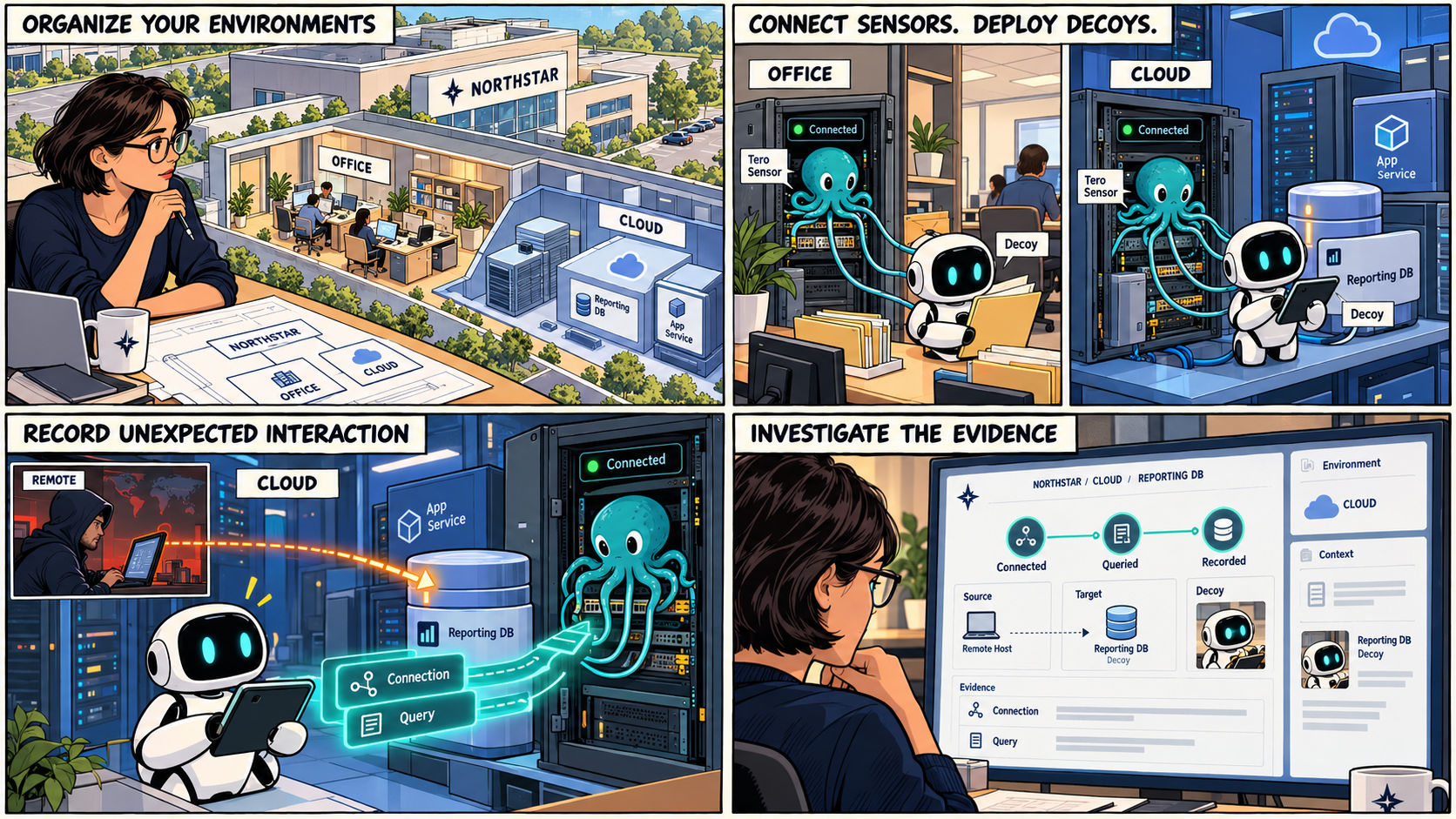
Start with your organization
Your Organization is your company inside Tero. Everything sits underneath it, so your environments, sensors, decoys and alerts stay connected in one place. If your company operates in several locations or cloud environments, you still manage them under the same organization.
Separate the places you want to protect
An Environment is simply somewhere you want Tero running. That might be your Barcelona office, your London network, AWS production, or a development environment. Keeping them separate makes it much easier to understand where something happened without losing the bigger picture across the company.
Put a Sensor where it matters
A Sensor is Tero’s presence inside that environment. It manages the protection you deploy there and sends useful security activity back to Tero. So if you want coverage in another office or cloud environment, you add another Sensor rather than rebuilding everything from scratch.
Give suspicious activity something to find
The Sensor manages Decoys. These are controlled systems designed to look like the kind of infrastructure someone exploring your environment might be interested in. A real employee or application should have no reason to touch them. That is what makes the interaction valuable. If something does interact with a decoy, Tero has a reason to pay attention.
Turn activity into something useful
From there, Tero keeps the full story connected. An Event records what happened. An Alert tells your team what deserves attention. The Evidence gives them the context to understand why. Instead of seeing a random warning, your team can see which environment was involved, which decoy was touched and what actually happened. That is the part that matters.
The same model works as you grow
Whether you are protecting one office or several environments, the structure stays the same:
And when something happens:
You do not have to learn a different model every time the company grows.
Where to go next
If you want to understand how Tero fits alongside the security tools you already use, read Add Protection Without Replacing Everything Else.
If you want to understand why decoys create a different kind of security signal, read Your Security Stack Watches Real Systems. Tero Watches What Nobody Should Be Touching..
And if you want a closer look at the component running inside each environment, read Introducing the Tero Sensor.
See it for yourself
The hierarchy makes much more sense when you see it working.
Book a demo and we’ll show you how Tero could map onto your own organisation.