
In this article
In this article
Security teams have more telemetry than ever, but more data does not always mean more clarity. Traditional security tools monitor legitimate systems, endpoints and network traffic for signs of compromise. That remains essential, but attackers increasingly understand what those systems look like and how to blend into normal activity.
Tero approaches the problem from another direction. Instead of waiting for an attacker to generate enough suspicious behaviour around a real asset, Tero gives them believable systems that should never receive legitimate interaction in the first place. At the centre of that approach is the Tero Sensor.
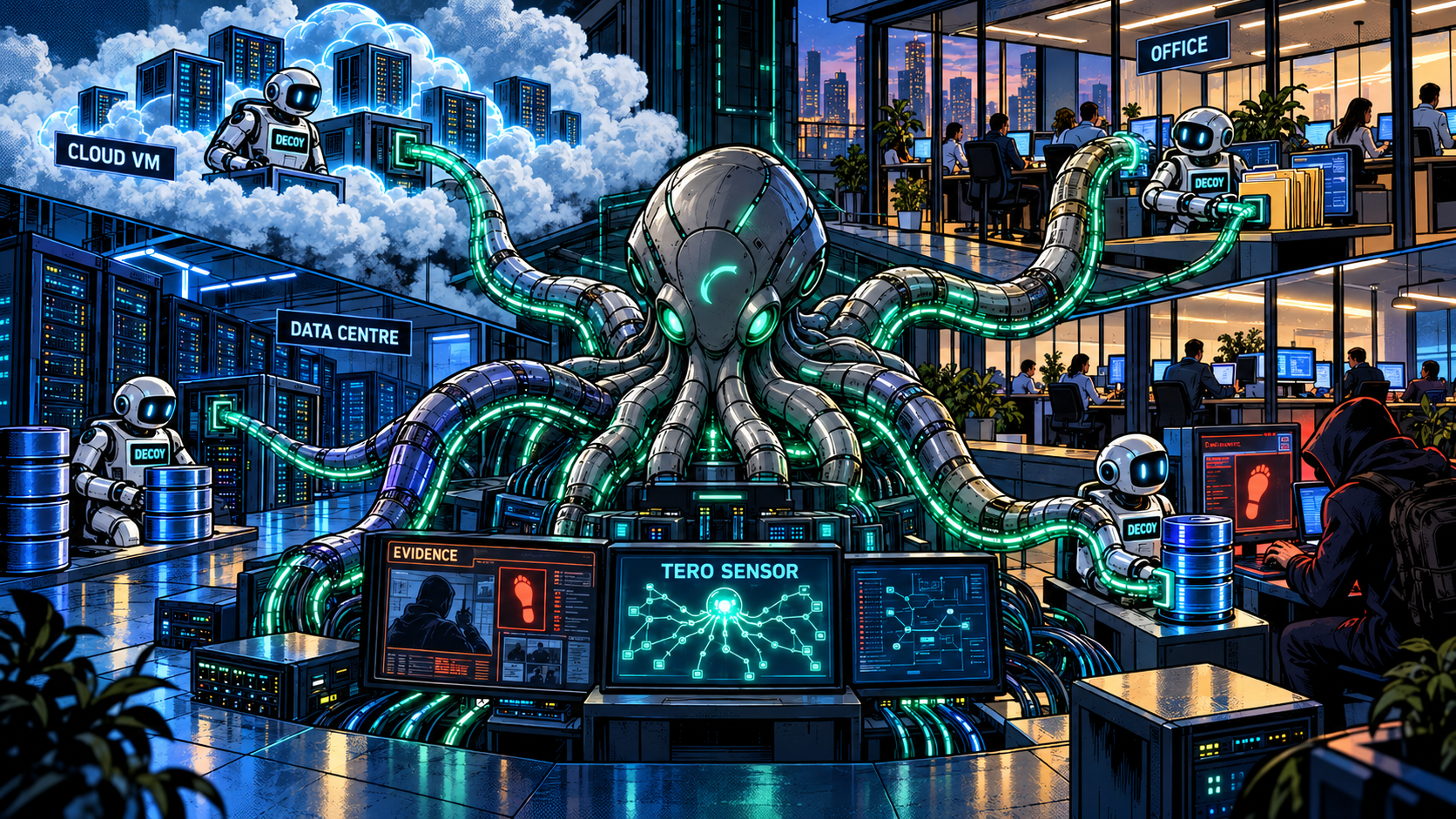
Bring deception closer to the environment
The Tero Sensor runs inside the environment you want to protect and manages the decoys deployed there. Those decoys imitate services and infrastructure an attacker could reasonably expect to find inside a business network.
The objective is not simply to expose an open port. A useful decoy needs to behave convincingly enough that suspicious interaction produces meaningful evidence. The Sensor manages each decoy, monitors its health and captures the activity taking place against it.
Turn suspicious interactions into useful evidence
A connection alone rarely tells the full story. The Tero Sensor observes activity such as connections, authentication attempts, successful access and service-specific behaviour generated against a decoy. Those observations are sent to the Tero control plane, where they become security events and, when appropriate, alerts.
Detect behaviour that should not exist
Deception security has a useful property: the signal begins with an asset that has no legitimate business user. A production database may receive thousands of valid requests. A decoy database should receive none.
“Deception should create clearer evidence, not more noise.
— Tero Engineering
Realistic decoys matter
Attackers look for inconsistencies. A fake system that immediately reveals itself as a honeypot has limited value. That is why Tero focuses on realistic service behaviour rather than superficial simulations.
Keep deception separate from what matters
A deception platform should not introduce new production risk while trying to detect an attacker. Tero decoys use controlled synthetic data and credentials and remain separate from real application data.
A clear view from the Tero console
Once enrolled, the Tero Sensor communicates with the Tero control plane and receives the configuration for its environment. From the Tero console, security teams can monitor sensors, deployed decoys, security events, alerts and investigation evidence from one place.
Deception complements your existing security stack
Tero is not designed to replace endpoint protection, SIEM, identity security or network monitoring. Deception adds another source of evidence: systems whose security value comes from the fact that legitimate users should not be touching them.
See Tero in action
The easiest way to understand deception security is to see what happens when someone actually interacts with a decoy. A Tero demo walks through deploying a Sensor, creating realistic decoys, generating suspicious activity and investigating the resulting evidence inside the Tero console.