
In this article
In this article
Uber’s MFA Fatigue Attack: Why Businesses Need Detection After Login
An approved login can still lead to a security incident. The 2022 Uber breach illustrates why businesses need strong authentication and visibility into activity inside their environment.
For CTOs and IT teams, the practical question is straightforward: if someone uses a legitimate account to get inside, what will help you notice their next move?
That is where Tero’s Sensors, Decoys and Endpoint Agent add detection opportunities and supporting evidence for your team’s investigations.
What happened in the 2022 Uber breach?
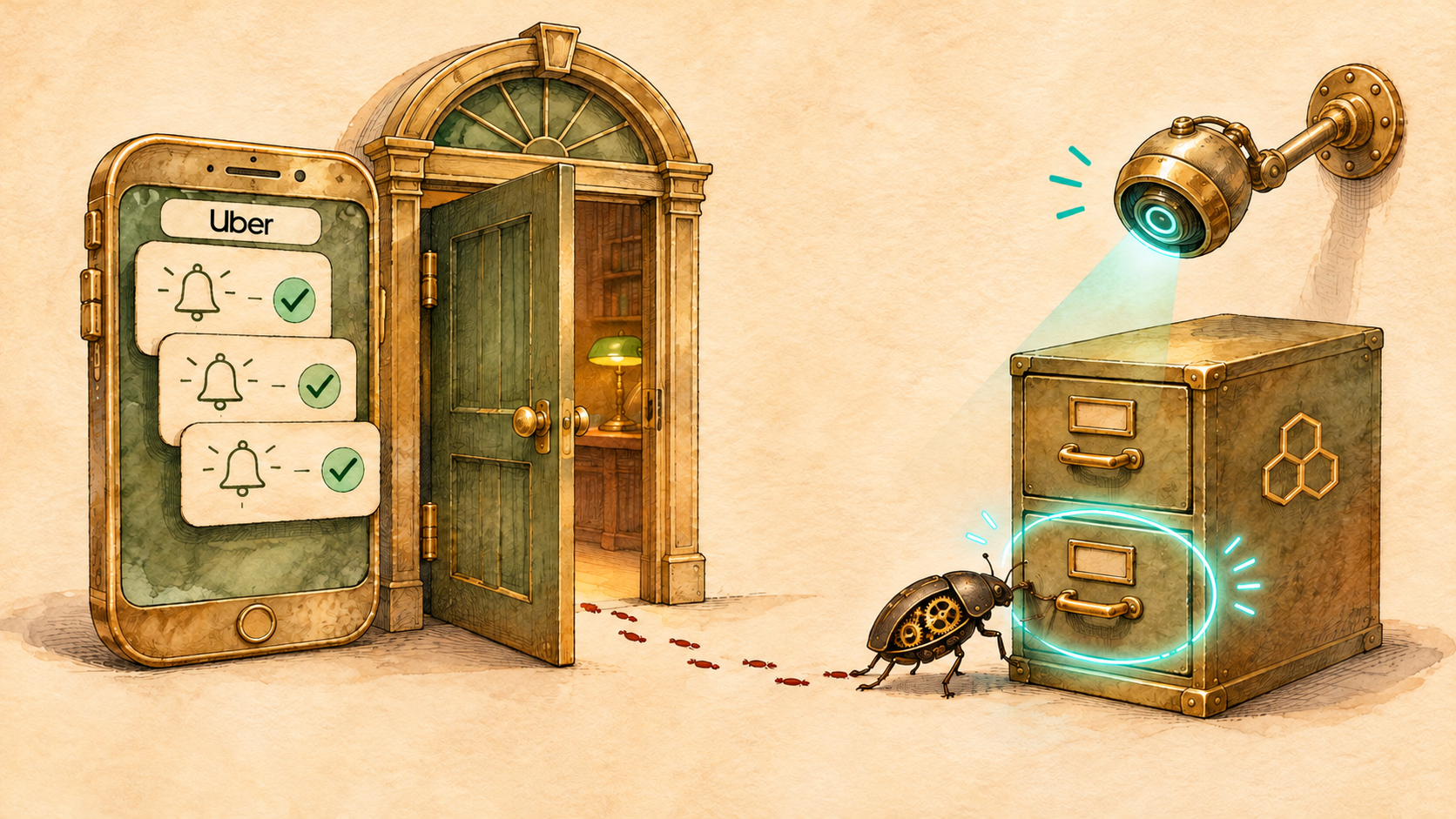
In its September 19 update, Uber said an attacker compromised an external contractor’s account. Repeated attempts triggered two-factor approval requests. The contractor initially resisted but eventually accepted one, allowing the attacker to sign in. Uber reported subsequent access to other employee accounts and internal tools, including Slack and G-Suite.
The security lesson extends beyond the login screen. A successful authentication event establishes access; defenders still need to assess what happens afterward.
What is an MFA fatigue attack?
An MFA fatigue attack, also called push bombing, pressures a person with repeated authentication requests until they approve an attempt they did not initiate.
It exploits the approval workflow and the confusion surrounding it. Staff need an easy way to report unexpected prompts, and security teams need a response that investigates the account rather than simply dismissing the notifications.
CISA recommends phishing-resistant MFA. When an organization cannot immediately deploy it, number matching is an interim improvement over simple push approval. It adds protection against approval fatigue without providing the same phishing resistance as FIDO-based authentication.
How passkeys strengthen business security
Passkeys use cryptographic credentials associated with the legitimate service. A correctly implemented passkey sign-in avoids handing a reusable password or typed one-time code to a lookalike login page.
Passkeys can be securely synced through a provider or remain bound to a specific device, including a hardware security key. Both approaches can provide phishing-resistant authentication.
Businesses should also protect account recovery, devices and authenticated sessions. A compromised session can allow actions under an existing login even when the original authentication used a strong method.
Pair stronger sign-in controls with internal threat detection so the team can investigate activity beyond authentication.
How Tero helps detect activity after account compromise
Tero gives businesses monitored assets that can reveal suspicious exploration inside their environment. Its Sensor-based Decoys provide opportunities to observe activity directed at systems and services that legitimate business work does not depend on.
This approach addresses a difficult detection problem: an intruder may use valid credentials and familiar tools.
CISA’s September 2026 cyber-decoy guidance identifies exactly that challenge. It describes how decoys can support detection of post-compromise activity, including discovery and lateral movement, and how they can complement a Zero Trust approach.
Place relevant Decoys where suspicious exploration may reach them
Tero supports Decoy types such as databases, file shares, SSH services and business portals. Teams can choose supported Decoys that make sense for the environment they want to monitor.
For example, a finance business might use a synthetic reporting database, an engineering environment an artifact-repository Decoy, or a shared-services network a file-share Decoy. These are illustrative deployments, separate from the reported Uber incident.
These assets create additional observation points. Their placement should reflect network access, likely discovery paths and the systems the business wants to protect.
Turn supported interactions into investigation evidence
When a supported Decoy interaction generates an eligible security finding, Tero brings that evidence into Events, Alerts and Investigations.
Depending on the protocol and recorded activity, evidence can include the source address, targeted service, timestamps and the action attempted. This helps the team move from a vague concern to a specific interaction it can investigate.
For example, unexpected activity against a Decoy database creates a concrete starting point: which source reached it, what interaction was recorded and what other available logs can explain the surrounding activity?
A source address is an investigation lead. Establishing the person or process behind it requires corroborating evidence.
Put activity in context before responding
Unexpected Decoy access deserves attention, but security teams should account for authorized scanners, testing and administrative activity.
Useful intrusion detection depends on relevant placement, understandable evidence and a response process that separates expected activity from unexplained access.
Tero’s organization and environment context helps teams review findings in the setting where they occurred.
How Tero’s endpoint agent contributes
Tero’s Chameleon Endpoint Agent evaluates supported files, sign-ins, program launches, network connections and system changes against security rules. It records matching security detections and the supporting evidence your team needs to investigate. Routine activity is evaluated transiently rather than retained as a general activity log.
Where endpoint policy and permissions support it, an authorized manager can approve a temporary restriction for a specified source IPv4 address and local TCP service. The action has a defined expiry and supports early reversal.
This connects a security finding with a reviewed response decision. Your team validates the source address and proposed scope before approval, then reviews delivery and the reported result.
A practical defence against MFA fatigue and internal intrusion
Start with phishing-resistant MFA for important accounts. Where migration takes time, use number matching as an interim measure and make unexpected authentication prompts easy to report.
Then review access permissions. Contractor and employee accounts should reach only the resources their roles require. Protect administrative access and make account recovery a deliberate, verified process.
Add internal observation points through relevant Decoys. Test that expected interactions produce usable evidence, identify who reviews findings and define how the team will verify and contain suspicious activity.
A successful login should be followed by continuing scrutiny of access and behaviour. Tero adds evidence that can help your team investigate that activity.
Frequently asked questions
Can attackers compromise accounts protected by MFA?
Yes. The outcome depends on the authentication method, its implementation and the surrounding recovery and session controls. Phishing-resistant MFA strengthens sign-in security; continued monitoring supports investigation after access is established.
Are passkeys phishing-resistant?
Yes. FIDO passkeys provide phishing-resistant authentication and can be either synced or device-bound. Protect the provider account, recovery process and authenticated sessions as well.
How can Decoys help detect lateral movement?
A Decoy can reveal activity when an intruder discovers or interacts with it. Strategically placed Decoys add observation points that help defenders investigate movement between systems. Their value depends on placement, supported visibility and integration with response processes.
How does Tero fit into an existing security stack?
Use phishing-resistant authentication to strengthen access and your existing endpoint and identity tools for their security signals. Tero adds Decoy detections and rule-matched endpoint findings with supporting evidence for connected investigations.
If an attacker got inside, would you know?
Your team needs more than confirmation that a login succeeded. It needs visibility into the activity that follows.
Explore Tero’s Sensors, Decoys and Endpoint Agent to see how security detections and supporting evidence help your team investigate suspicious activity.